
Planning for a Safer, More Reliable U.S. 23
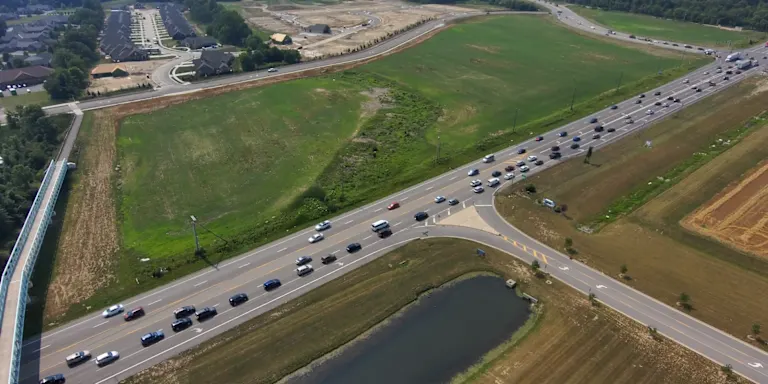
If you regularly travel U.S. 23 through Delaware County, you probably don’t need data to tell you the corridor is busy. Congestion, unpredictable travel times, and challenging intersections are part of the everyday experience for many drivers.
During a recent SourcePoint discussion, Danilo Puozzo, Transportation Engineer and Program Manager with the Ohio Department of Transportation (ODOT), joined Jackie Bain, Community Health Specialist with the Delaware Public Health District, to talk about the Route 23 Connect Study and what it could mean for the future of the corridor.
PUBLIC HEARING
ODOT will host a public meeting at the end of October to share more information and answer questions about 23 Connect. Stay tuned for more information.
Why U.S. 23?
The Route 23 Connect Study focuses on U.S. 23 between I-270 and Waldo and was launched in response to three interconnected concerns: growth, congestion, and safety.
The corridor currently carries nearly 30% more traffic than it was designed to handle, contributing to bottlenecks and unreliable travel times. There are also 39 signalized intersections between I-270 and Waldo, creating numerous points where traffic must stop, turn, and cross. Left turns are an especially important safety consideration.
The challenges extend beyond Delaware County. U.S. 23 is an important north-south connection linking the Columbus region with northwest Ohio, Michigan, and Canada. Improving the corridor can therefore support both local mobility and the region’s role as a national logistics hub.
From Study to Solutions
Route 23 Connect isn’t a single road construction project. Instead, ODOT has been evaluating the corridor to identify potential improvements and develop a long-term action plan.
During the SourcePoint discussion, Puozzo reviewed four types of improvements evaluated in the study:
- Traditional freeway interchanges would carry U.S. 23 traffic over or under the intersecting road, eliminating signals and left turns to and from U.S. 23. They would keep through traffic moving but require the most land, carry the highest cost, and add bridges that must be maintained.
- Connector road interchanges would redirect traffic to a nearby interchange rather than place one directly at the existing intersection. This offers greater flexibility to avoid nearby properties, but drivers entering or leaving U.S. 23 may travel farther and navigate lower-speed turns.
- Restricted Crossing U-Turns, or RCUTs, would require drivers on the intersecting road to turn right and use a designated U-turn rather than cross U.S. 23 or turn left directly onto it. RCUTs cost less and require less land than interchanges but may add time and distance for drivers on the intersecting road.
- Overpasses and underpasses would allow the intersecting road to cross above or below U.S. 23 without connecting to it. This would eliminate conflict points and through-traffic delays but could create longer routes to nearby homes and businesses.
The goal is not necessarily to apply the same solution everywhere. Each intersection has different traffic patterns, safety concerns, surrounding development, access needs, and physical constraints. ODOT’s initial recommendations identify the options that appeared most promising during the feasibility study, but additional engineering, environmental review, public input, funding, and design work would be required before an improvement moves forward.
The options and initial recommendations for U.S. 23 are summarized in the 2024 Preliminary Feasibility Study.
A recommendation does not mean a project is fully designed, funded, or scheduled for construction. Each improvement must advance separately through environmental review, engineering, right-of-way acquisition, and construction. Funding may include federal and state transportation dollars, local or regional contributions, and competitive grants. Because funding is limited and may be secured in stages, improvements along U.S. 23 are likely to move forward as individual projects over several years rather than as one corridor-wide construction project.
Two intersection projects north of the city of Delaware are already moving forward:
U.S. 23 at State Route 229
U.S. 23 at Coover Road
Safety is Part of the Conversation
Congestion was a major concern among participants, particularly the stretch of U.S. 23 from I-270 north through the Orange Road area. Participants described frustration with traffic, concerns about safety, and questions about how future roadway changes could affect nearby properties.
According to information reviewed during the discussion using the Ohio State Highway Patrol’s interactive OSTATS Dashboard, 3,963 crashes were reported in Delaware County in 2025, including 559 crashes along U.S. 23—approximately 14% of all crashes reported in the county that year.
What Can Drivers Do Today?
Long-term infrastructure improvements take time, but drivers can take steps now to improve their safety.
Bain emphasized the importance of defensive driving—remaining alert, anticipating the actions of other drivers, and giving yourself enough time and space to respond to unexpected situations. If you encounter a driver whose behavior appears unsafe, Ohio motorists can dial #677 to contact the Ohio State Highway Patrol.
The Delaware Public Health District also provides driver safety programs throughout the year, many hosted at SourcePoint.
TRY IT YOURSELF
Curious about a road or intersection you regularly travel? Use the OSHP Crash Dashboard to explore where crashes have occurred and look for patterns along your route. The dashboard’s crash count provides an aggregate view, while the crash point map shows individual crash locations. The information can help drivers explore alternate routes or potentially less stressful times to travel.
Stay Informed and Have a Voice
The Route 23 Connect Study is about more than moving vehicles faster. It is an opportunity to think about how a growing Delaware County can move people more safely, efficiently, and reliably in the years ahead.
ODOT plans to hold a public meeting at the Delaware County Fairgrounds to share more information and provide another opportunity for residents to learn about the project.
SourcePoint will share meeting details on our website and social media when they become available.
In the meantime, residents can visit ODOT’s Route 23 Connect website to learn more about the study, review project materials, and explore the proposed concepts.
Useful Links
- Route 23 Connect
- 2024 Preliminary Feasibility Study
- U.S. 23 and SR 229 Intersection Improvements
- U.S. 23 and Coover Road Intersection Improvements
- OSHP Crash Dashboard
Related driving resource: Roundabouts are an increasingly common intersection design throughout Delaware County, with additional locations planned. Drivers who would like a refresher can read SourcePoint’s Positive Aging: Master the Roundabout.